21+ — flagged for suggestive
History of CostumesNo. 1435 · The 2026 edition
Slutty Halloween Costumes: A Cultural History
Discover the surprising origins of risqué Halloween attire—and how it became a controversial tradition.
Our own summary of the original — the full post and photos live at fastcompany.com.
Explore the evolution of 'sexy' Halloween costumes from their early roots to modern debates about empowerment and objectification.
About this
A cultural history of sexy Halloween costumes. It surveys examples in a Manhattan costume shop, traces Halloween's roots from Samhain and All Saints/All Souls to 19th-century marriage divination, and cites historians on how courtship and masquerade balls shaped provocative costume traditions.
Facts from the original
- A Manhattan costume shop visited recently displayed women's sexy disguises.
- The shop's sexy costumes included a sexy witch, sexy nurse, sexy majorette, sexy bumblebee, sexy pirate, and sexy detective wearing a sexy deerstalker.
- The shop also had a sexy Super Girl, sexy Snow White, sexy Strawberry Shortcake, and sexy Little Bo Peep.
- Additional costumes included a sexy Dorothy, sexy Glinda, sexy Scarecrow, and sexy Cowardly Lion.
- Submarine Sally is a sexy sailor.
- Backdraft Babe is a sexy firefighter.
- Officer Tara U. Clothesoff is a sexy policewoman.
- The page jokes that Officer Tara U. Clothesoff should investigate a Girl Scout troop with a sexy Girl Scout called Don't Touch My Cookies offering thin mints.
- Sexy American history costume options include Pocahottie (sexy Pocahontas) and Pilgrim's Pleasure (sexy pilgrim).
- The Manhattan shop's sexy costume section has a sexy costume for everyone.
- Sexy French maid options include Upstairs Maid, Francesca the Maid, and Maid My Day.
- One can be a sexy cat, a sexy maid, or both as Maid PurrFect at the same time.
- The sexy costume is now as much a part of Halloween as candy corn and Tootsie Rolls.
- Candy corn and Tootsie Rolls are available in sexy-costume form.
- Provocative dress seems modern, especially to parents who remember Alice In Wonderland costumes without garter belts.
- The history of the sexy costume involves the potato famine, 19th-century class and race relations, and the 21st-century globalized marketplace.
- Halloween was about sex before it was about trick or treat.
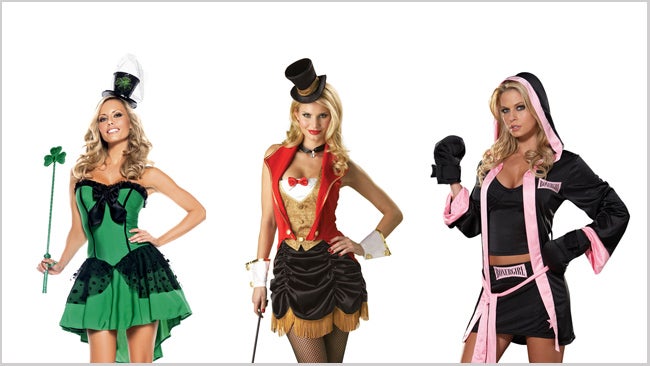
- The page lists inexplicable sexy costumes including a sexy leprechaun, a sexy circus barker, and a sexy boxer.
- Early Halloween costumes were decidedly unsexy.
- In Dressed for Thrills: 100 Years of Halloween Costumes and Masquerade, essayist Mark Alice Durant writes that people disguised themselves as animals during Samhain to allay the restless souls of the dead.
- Samhain was a Celtic festival and a precursor to Halloween.
- Centuries later, people celebrated Catholic All Saints' Day and All Souls' Day with parades, wild parties, and more costumes.
- All Saints' Day and All Souls' Day are additional influences on modern Halloween observances.
- In some All Saints' and All Souls' celebrations, boys cross-dressed as girls.
- All Saints was supposed to honor the saints and martyrs of the Roman Catholic Church.
- Historian Nicholas Rogers writes in Halloween: From Pagan Ritual To Party Night that sex entered the discussion of All Saints; its liturgy referred to wise virgins awaiting the coming of the bridegroom, anticipating forthcoming marriages and a replenishing of the Christian flock.
- By the 19th century, Halloween held special significance as an occasion for predicting wedding bells.
- A once-death-obsessed holiday had blossomed into something more life-affirming.
- Rogers explains that the way stones settled in bonfires, nuts cracked in the hearth, kale stalks pulled from the ground, and people or sounds encountered at midnight at a crossroads or stile were windows to the future.
- Some Halloween rites foretold deaths, a predictable message given the holiday's long association with dying.
- Death-foretelling rites persisted in Ireland after the potato famine of the mid-nineteenth century.
- Where killer epidemics declined and the demographic fortunes of young people improved, at least after infancy, Halloween spells and omens increasingly focused on future marriage prospects: who, when, and whether one would marry, and whether one's partner would be handsome, faithful, or chaste at marriage.
- In villages at the time, everything from where one slept to where one worked was divided strictly according to gender.
- As a result, one of the few places young couples could flirt and court was at public festivals like Valentine's Day and May Day.
- Rogers writes that Halloween became one of those occasions in the ritual year when young adolescents tried to channel their sexuality into more permanent union.
- Valerie Steele, director of the Museum at FIT, says the historical precedent for sexy costumes is the sexy costumes at masquerade balls, which were wildly popular from the 18th and 19th century on.
- Steele says respectable women would wear pantaloons or short skirts and milkmaid outfits when they went to costume parties.
- At masquerade parties in London, costumes had a degree of body exposure.
- There were also artists' balls, especially in Paris, where there were revealing costumes and some nudity.
From the original
The page explores how the sexy Halloween costume became a staple. It opens in a Manhattan costume shop, cataloging dozens of provocative takes on witches, nurses, pirates, superheroes, storybook characters, maids, cats, and historical figures, and notes that sexy versions of candy corn and Tootsie Rolls exist too. It asks how provocative dress became normal for Halloween, suggesting the answer spans the potato famine, 19th-century class and race relations, and 21st-century globalization. According to Dressed for Thrills, early Samhain disguises imitated animals to placate restless dead souls. Later Catholic All Saints' and All Souls' observances included parades, parties, and cross-dressing. Historian Nicholas Rogers argues that All Saints liturgy linked wise virgins to awaiting bridegrooms, and by the 19th century Halloween became a time for predicting marriage. Divination rituals read bonfire stones, cracking nuts, kale stalks, and midnight encounters as omens; in Ireland after the potato famine, such rites still foretold death, but as epidemics declined and young people's prospects improved, they increasingly focused on future spouses. Village life separated genders at work and sleep, so public festivals like Valentine's Day and May Day became rare courtship spaces, with Halloween helping adolescents channel sexuality toward permanent union. Valerie Steele of the Museum at FIT traces sexy costumes to 18th- and 19th-century masquerade balls, where respectable women wore pantaloons, short skirts, or milkmaid outfits; London masquerades allowed body exposure, and Paris artists' balls featured revealing costumes and nudity.