Jack-o'-Lantern LoreNo. 2649 · The 2026 edition
Origin of the Giant Pumpkin
How did prize-winning pumpkins become colossal? Uncover the surprising origins of the giant pumpkin tradition.
Our own summary of the original — the full post and photos live at nybg.org.
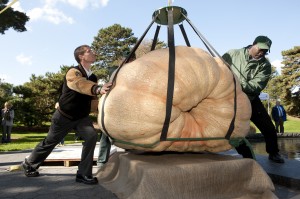
The giant pumpkin phenomenon began in the 19th century with the rise of agricultural fairs and competitive gardening. Early growers selected the largest varieties and experimented with techniques. The modern obsession with record-breaking pumpkins traces back to these humble beginnings, evolving into a global hobby with dedicated competitions.
About this
A New York Botanical Garden "Plant Talk" essay by Thomas C. Andres tracing how wild baseball-sized Cucurbita squashes became today's record-breaking giant pumpkins. It covers prehistoric megafauna dispersal, domestication, breeding history, and cultivation practices, and predicts a 2,000-pound pumpkin around 2014.
Facts from the original
- Thomas C. Andres is an Honorary Research Associate at the New York Botanical Garden.
- Three record-breaking pumpkins were on display at the New York Botanical Garden in October 2010.
- The heaviest displayed pumpkin is not only the heaviest fruit ever grown but the heaviest fruit in the plant kingdom.
- The species scientific name Cucurbita maxima says it all.
- Andres works at the Garden with Michael Nee on the taxonomy of genus Cucurbita.
- Cucurbita includes a little over a dozen species: squashes, pumpkins, and certain gourds.
- All Cucurbita originally grew wild in the tropical and subtropical Americas.
- Five of the species were domesticated and are some of the oldest New World crop plants.
- Italy not only lacked tomatoes before Columbus, it had no zucchini.
- Wild Cucurbita fruit are like a baseball in size, shape, and almost hardness.
- Wild Cucurbita often grow in flood plains and float during floods, but only downstream.
- A widely held theory says wild Cucurbita are anachronisms left from the Pleistocene with extinct dispersal agents.
- Possible dispersers included giant ground sloths, toxodons, gomphotheres, and mastodons.
- These megafauna went extinct during the Late Pleistocene, around 10,000 years ago.
- The extinctions came soon after humans crossed the land bridge from Asia into the Americas.
- The new migrants abandoned hunter-gatherer life, became sedentary, gathered in larger groups, and relied on agriculture.
- Early farmers shaped wild Cucurbita, selecting for palatability and size plus secondary traits like softer rinds and various shapes and colors.
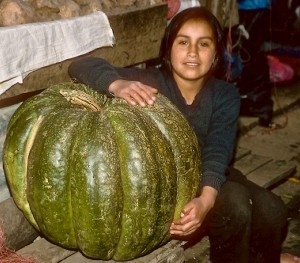
- By the time of the European Conquest, squash of up to 200 lbs (90 kg) were common in South America.
- Today's World Record-holder weighs 1,810.5 lbs (821.23 kg).
- Plants had to be moved out of the tropics: tropical season is long but days are short and large fruits face many pests and diseases.
- At our latitude fruits can grow quickly during the long summer days.
- C. maxima fruits from South America reached New England and Europe in the 1700s.
- Selective breeding aimed at larger fruit began in earnest a little over a hundred years ago when more diversity allowed different cultivars to be crossed.
- In 1893 a 365-pounder from Ontario grown by William Warnock was exhibited at the Chicago World's Fair.
- In 1900 Warnock took the prize at the World's Fair in Paris with the first 400 lb pumpkin.
- For the next 70 years little changed in this maximum weight.
- In the 1970s and 80s records started being broken when Howard Dill of Nova Scotia bred the 'Atlantic Giant' pumpkin.
- 'Atlantic Giant' is the basis for all giant pumpkins today.
- It has been known since at least William Warnock's time that only one fruit per vine should be allowed to ripen for maximum size.
- Many other improvements concerning soil, leaves, and fruit treatment are still being discovered and tweaked.
- Best cultivation practices are a constant source of discussion and debate among giant pumpkin growers.
- The final ingredient in growing a record-breaking pumpkin is luck.
- Gravity has taken its toll on many giants, which can literally be crushed by their own weight like a beached whale.
- Great care must be taken to prevent the sun from overheating one side of the fruit and causing an explosion.
- In 1996 the milestone of the first over-1,000-pound pumpkin was reached; there were two that year.
- Since then hundreds of pumpkins have exceeded 1,000 pounds.
- There obviously is a weight limit, but Andres declines to guess what it is.
- Prize-winning growers say a one ton (2,000 lbs) pumpkin will not only happen soon but that they are actively working on that goal.
- Graphing record-breaking pumpkins each year and extrapolating to 2,000 pounds predicts the achievement around the year 2014.
- Andres suggests a weight that year of 2,014 lbs would be most appropriate.
- The displayed pumpkins were to be cut open at the end of October 2010 to extract the seeds.
- The post appeared in the Programs and Events and Science categories on October 26, 2010.
- Commenter Ruth Kassinger praised the story on plants people don't often think about.
- Commenter Steve praised the article for telling the history of giant-plant growing.
From the original
Writing for the New York Botanical Garden's Plant Talk blog on October 26, 2010, Honorary Research Associate Thomas C. Andres explains how the giant pumpkin came to be, prompted by three record-breaking pumpkins displayed at the Garden that month—the heaviest being the heaviest fruit ever grown and the heaviest in the plant kingdom, a Cucurbita maxima. He works with Michael Nee on Cucurbita taxonomy; the genus holds a little over a dozen species of squashes, pumpkins, and some gourds, all originally wild in the tropical and subtropical Americas, with five domesticated species among the oldest New World crops. Wild fruits were baseball-sized, nearly that hard, and grown in flood plains, floating only downstream. A widely held theory holds they are Pleistocene anachronisms whose dispersal agents—giant ground sloths, toxodons, gomphotheres, mastodons—went extinct around 10,000 years ago, soon after humans crossed from Asia. Those migrants became sedentary farmers who selected wild Cucurbita for palatability and size. By the European Conquest, 200-pound squashes were common in South America. Reaching the 1,810.5-pound modern record took tropical plants moving to New England and Europe in the 1700s, deliberate size breeding from about a century ago (William Warnock's 365-pounder in Chicago in 1893 and first 400-pounder in Paris in 1900), Howard Dill's 1970s–80s 'Atlantic Giant', better cultivation, and luck. The first 1,000-pounders came in 1996; Andres projects a one-ton pumpkin around 2014.
More photos

Photos hosted by nybg.org.