Trick-or-Treating HistoryNo. 1607 · The 2026 edition
“Trick?” or “Treat?” – Unmasking Halloween
Ever wondered why we say "Trick or Treat?" during Halloween? This article explores the fascinating history and traditions behind this iconic phrase, revealing how it evolved from ancient customs to th
Our own summary of the original — the full post and photos live at web.archive.org.
The article delves into the origins of the phrase "Trick or Treat?" and its connection to Halloween traditions. It traces the evolution of this custom from its roots in ancient festivals to its current form, highlighting the cultural shifts and influences that shaped the way we celebrate Halloween today.
About this
An article from The Restored Church of God tracing the pagan and Catholic roots of Halloween and arguing against Christian observance of the holiday. It walks through Celtic Samhain, Roman festivals, the Catholic Church's All Saints' and All Souls' Days, and the customs' journey to America, then presents a scriptural case that Halloween contradicts God's truth. It closes with a list pairing common Halloween customs with their claimed ancient origins.
The list
-
01
Mischief-making, playing tricks
Celts believed the ghosts of the dead who returned to earth on the night of Oct. 31 caused trouble and damaged crops; they also believed their gods played tricks on them.
-
02
Black cats
Celts believed bad spirits would take the form of cats and other animals on the night of Oct. 31.
-
03
Costumes
Celts and other Europeans wore masks when leaving home after dark so ghosts would not recognize them and might mistake them for fellow spirits; "Guisers" impersonated the returning dead, singing and dancing to keep evil spirits away; Catholics dressed as saints, angels and devils during Hallowmas.
-
04
"Trick or treat"
Before the Protestant Reformation, women and girls went "souling," visiting houses and begging for "soul cakes"; 17th-century Irish peasants went door to door asking for donations for a feast honoring St. Columba (believed to have replaced the Lord of the Dead); up until the early 1900s the Irish asked for contributions in the name of "Muck Olla," a legendary gigantic boar.
-
05
Bonfires
Druids built sacred bonfires on Oct. 31, the eve of the new year, to frighten off evil spirits; worshippers burned animal and crop offerings to their sun god and rekindled cooking fires to protect their homes. The Scots built bonfires called Samhnagan for Halloween merry-making and as a defiant welcome to the coming winter. The Catholic Church continued the bonfire tradition on All Souls' Day, Nov. 2.
-
06
Fruits, nuts and other goodies
Handing out fruits and nuts may have originated from Pomona Day, named for the Roman goddess of fruits, trees, gardens, harvests and fertility; they were later used for divination games.
-
07
Apple-bobbing, apple-ducking
May have come from Pomona Day, as the Romans viewed the apple as a sacred symbol of their goddess Pomona. Apple-ducking was a divination game used to predict future love and marriage; a girl peeling an apple before a mirror in a candle-lit room would see an apparition of her future husband behind her. Apple-ducking also represented soul symbols (apples) in the Cauldron of Regeneration (the water), akin to the lord of the dead gathering dead souls to regenerate those condemned to inhabit animals for the past year.
-
08
Parades, parties
The Scots, Celts and Welsh built bonfires for parading, dancing and merry-making; the Celts did so wearing costumes made from animal skins and heads. The Scots assembled marriage-minded young people for divination games. Europeans who migrated to America brought "play parties" and public events celebrating the harvest, along with telling ghost stories and pulling pranks.
-
09
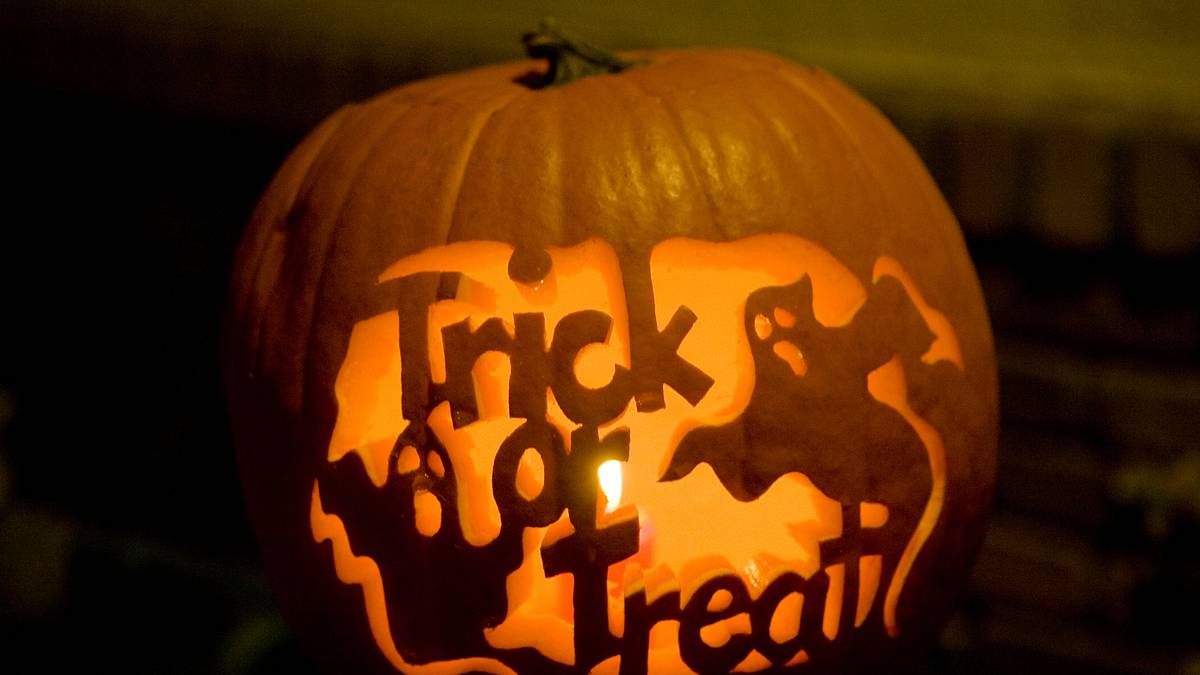
Jack-o'-lantern
The name may have come from a night watchman. In the British Isles, turnips and rutabagas were commonly used, while pumpkins are the American tradition. In Britain, people hollowed out turnips and placed candles inside them to make food offerings to the dead; later they were posted just outside homes to keep away evil spirits.
Facts from the original
- Americans spend $2.5 billion on Halloween each year, making it the second largest holiday after Christmas.
- The ancient Celts lived 2,000 years ago in what is now Ireland, Great Britain and Northern France.
- The Celts were pagan nature worshippers with many gods, including the sun, which they believed commanded their work and rest times.
- The Celts believed the sun maintained the earth, kept it beautiful, and caused their crops to grow.
- The Celts observed their new year on November 1, marking the end of the harvest and summer ("the season of the sun") and the start of the cold, dark winter ("the season of darkness and cold").
- From October 31 to November 2 the Celts celebrated a 48-hour festival, the Vigil of Samhain (pronounced "sow-in").
- The Celts believed Samhain, the pagan lord of the dead, assembled the souls of those who had died during the previous year and decided what form they would take for the next year.
- Souls would either pass on to human bodies or be condemned to live within animals, with the most evil of the bad souls or spirits taking the form of cats.
- Celtic worshippers tried to bribe Samhain with gifts and prayers to coax him into giving lighter sentences.
- The Encyclopedia Britannica describes Samhain (Celtic for "End of Summer") as one of the most important and sinister calendar festivals of the Celtic year, held on November 1, when the world of the gods was believed made visible to mankind and the gods played tricks on their mortal worshippers.
- Sacrifices and propitiations of every kind were thought vital, for without them the Celts believed they could not prevail over the perils of the season or counteract the activities of the deities.
- The Encyclopedia Britannica calls Samhain an important precursor to Halloween.
- On the night of October 31, after harvesting and storing crops, the Celts first extinguished the cooking fires in their homes.
- Druids (Celtic priests) met on hilltops in the dark oak forests, which they viewed as sacred, and built huge sacred bonfires to frighten away evil spirits and to honor the sun god.
- The people burned crop and animal sacrifices to their gods, dancing around the fires as the "season of the sun" passed and the "season of darkness" began.
- The Celts wore costumes of animal heads and skins and told each other their fortunes.
- The next morning the Celts re-lit their cooking fires from the sacred bonfires to free them from evil spirits and to help protect them during the coming winter.
- According to the Encyclopedia Britannica, the Celtic festival of Samhain eve was observed on October 31 at the end of summer in ancient Britain and Ireland, as one of the ancient fire festivals when huge bonfires were set on hilltops to frighten away evil spirits.
- The souls of the dead were thought to revisit their homes on this day, and the autumnal festival acquired sinister significance, with ghosts, witches, hobgoblins, black cats, fairies and demons of all kinds said to be roaming about.
- Halloween was thought to be the most favorable time for divinations concerning marriage, luck, health and death.
- Hebrews 2:14 identifies the devil as him who had the power of death, so the ancient Celts, thinking they served God, were deceived into worshipping the god of this world.
- Matthew 22:31-32 states God is not the God of the dead but of the living, so there must be a resurrection from the dead so the patriarchs might live and serve Him.
- Romans 14:9 states Christ died and rose and lived again that He might be Lord of both the dead and the living, and He gained the keys of the grave and death (Rev. 1:18).
- During the first century the Roman Empire invaded Ireland and the British Isles, conquering most Celtic territory and ruling over the Celts for hundreds of years, influencing Celtic and Anglo-Saxon customs.
- Two Roman festivals mixed with the Celts' festival of Samhain: Feralia and Pomona Day.
- Feralia, held on February 21, was a Roman holiday designed to honor the dead but essentially amounted to mass drunkenness and orgies.
- Pomona Day, celebrated on November 1, was a festival in honor of Pomona, the Roman goddess of fruit, trees and fertility, whose sacred symbol was the apple.
- Several American cities bear the pagan name Pomona, thereby unwittingly endorsing "Pomona Day."
- In A.D. 313 the Roman Catholic Church found favor with Emperor Constantine, and for the first time the pope, backed by Roman civil authority, had free reign to determine what was "Christian."
- The article claims the Roman Catholic Church began with the sorcerer Simon Magus, mentioned in chapter eight of the Book of Acts.
- Early Catholic worshippers observed special anniversaries for martyrs, and when there were not enough days in the year, the Catholics observed one feast day for all martyrs.
- The Catholic Encyclopedia notes that in the fourth century neighboring dioceses began to interchange feasts, transfer relics and join in a common feast, and that because martyrs became too numerous for separate days, the Church appointed a common day for all.
- Pope Boniface IV, in A.D. 609, declared Feralia to be Christian, renamed it All Saints' Day, changed it from drunken revelries to a day of prayer and meditation honoring dead "saints," and moved its observance from February 21 to May 13.
- Boniface IV consecrated the Pantheon in Rome to the Blessed Virgin and all the martyrs, ordering an anniversary.
- Pope Gregory III, who reigned 731-741, consecrated a chapel in the Basilica of St. Peter to all the saints, fixed the anniversary for November 1, and broadened the festival of All Saints' Day to include all saints as well as all martyrs.
- Pope Gregory IV (827-844) moved All Saints' Day from May 13 to November 1, the same day as Samhain, officially extending the festival to the entire church.
- All Saints' Day became known as All Hallows Day, while October 31 became All Hallows Eve and eventually Halloween.
- In A.D. 988 the Catholic Church instituted All Souls' Day on November 2 to commemorate all the faithful departed, those baptized Christians believed to be in purgatory because they died with guilt of lesser sins on their souls.
- Roman Catholic doctrine holds that the prayers of the faithful on earth will help cleanse purgatory souls to fit them for the vision of God in heaven; the date became practically universal before the end of the 13th century and was chosen to follow All Saints' Day.
- Catholic believers celebrated Hallowmas with huge bonfires, parades and costumes, masquerading as dead saints, angels and demons.
- All Saints' Eve (October 31), All Saints' Day (November 1) and All Souls' Day (November 2) combined into Hallowmas, mirroring the Celtic Vigil of Samhain.
- In 1517 Martin Luther chose Halloween night to post his ninety-five theses on the door of the church in Wittenberg, Germany, effectively starting the Protestant Reformation, because he understood large crowds would be moving through the streets that evening.
- As European immigrants settled in the United States, they brought customs, traditions, superstitions and religious practices, including Halloween, from their homelands.
- The biggest Halloween influence in America came with the millions of Irish settlers who immigrated after fleeing Ireland's potato famine of 1846.
- Halloween, like Christmas, became a secular holiday for all, with festivities including parades, parties, costumes, treats and mischief.
- Today's Halloween customs (black cats, parades, dressing up as ghouls and witches, parties, bonfires, tricks and mischievous pranks) point directly back to the Vigil of Samhain, pagan Roman holidays filled with immoral revelries, and the Catholic Church's Hallowmas.
- Romans 1:21-25 describes people who knew God but did not glorify Him, became futile in their thoughts, and exchanged the truth of God for the lie, worshipping and serving the creation rather than the Creator.
- Matthew 6:25-33 tells people not to worry about food, drink or clothing, for the Gentiles seek such things; instead they should seek first the kingdom of God and His righteousness.
- The Celts put their trust in "sacred bonfires" to protect them from evil spirits instead of trusting God as their Protector (Psalm 18:2-3, 29-31, 47-48).
- The Celts believed in the immortality of the soul, which the article calls a false doctrine Satan taught man in the Garden of Eden (Gen. 3:1-5) and has used to deceive the world ever since (Rev. 12:9).
- The article asserts that when you die, you die: no going to heaven (John 3:13; Acts 2:29, 34), no roaming the earth haunting houses, no eternity in Purgatory; the dead know nothing (Ecc. 9:5); the soul who sins shall die (Ezek. 18:4); and the wages of sin is death (Rom. 6:23), not eternal life.
- Jeremiah 10:2-3 (KJV) says, "Learn not the way of the heathen...for the customs of the people are vain."
- God commanded Israel not to follow the doings of the land of Egypt or the land of Canaan (Lev. 18:3) and not to defile themselves with the abominable customs of the surrounding nations (Lev. 18:24-30).
- God told Israel they would be blessed beyond human imagination for carefully keeping His laws (Lev. 26:3-13) and greatly cursed for rejecting Him and replacing His ways with pagan customs, no matter how innocent they seemed (Lev. 26:14-39).
- Israel mocked God's messengers, despised His words and scoffed at His prophets (II Chron. 36:15-16), so God punished them; the article says modern-day descendants of Israel — the United States, Canada, Britain, Australia, Israel and others — will soon be severely punished for failing to discern what is holy from what is profane (Jer. 30:4-7; Ezek. 24:13-14).
- Satan blinds the world to his lies (II Cor. 4:4; Rev. 12:9), transforms himself into an angel of light, and has ministers who transform themselves into ministers of righteousness (II Cor. 11:14-15).
- Jeremiah 10:23 says the way of man is not in himself, and Jeremiah 17:9 says the heart is deceitful above all things and desperately wicked.
- The article compares Halloween to a gleaming, white-washed tomb (Matt. 23:27): sparkling on the surface but, in God's eyes, filled with every spiritually unclean thing and a foul stench to His nostrils (Isa. 65:5).
From the original
Published by The Restored Church of God, this article argues that Halloween is not harmless fun but a festival whose customs descend from pagan religion. It begins with the ancient Celts of Ireland, Great Britain and Northern France, nature worshippers who revered the sun and began their new year on November 1, when harvest ended and winter began. From October 31 to November 2 they held the 48-hour Vigil of Samhain, believing the pagan lord of the dead assembled the year's souls and assigned them new forms — human bodies or animals, with the worst spirits becoming cats. Celts doused their hearth fires; Druid priests lit sacred hilltop bonfires to scare evil spirits and honor the sun god; people burned crop and animal sacrifices, wore animal heads and skins, told fortunes, and relit their fires from the bonfires the next morning. Roman conquest added Feralia, a February 21 festival of the dead marked by drunkenness, and Pomona Day on November 1, honoring the goddess of fruit and trees whose symbol was the apple. The Catholic Church then repackaged these observances: Pope Boniface IV made Feralia "Christian" as All Saints' Day in A.D. 609, moving it to May 13; Gregory III fixed November 1; Gregory IV moved the feast to November 1, aligning it with Samhain, so October 31 became All Hallows Eve and eventually Halloween. All Souls' Day was added in A.D. 988, forming Hallowmas. The article then turns to scripture to argue that the holiday's doctrines contradict the Bible and that God condemns pagan customs, concluding that Christians should not observe Halloween.